
American Fairytale (Audiobook): a Review by Caz
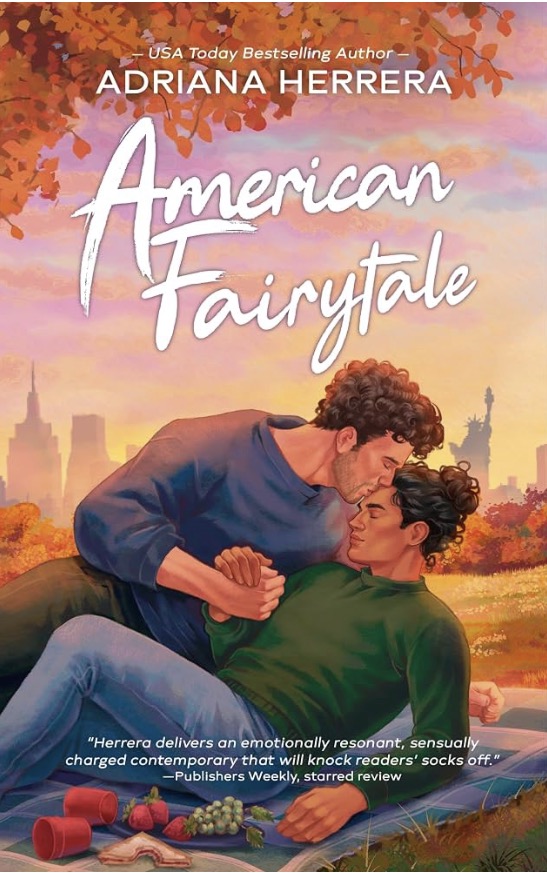
Narrators: Victor Quixabas & Gomez Pugh
Fairy-tale endings don’t just happen; they have to be fought for.
New York City social worker Camilo Santiago Briggs grew up surrounded by survivors who taught him to never rely on anything you didn’t earn yourself. He’s always dreamed of his own happily-ever-after, but he lives in the real world. Men who seem too good to be true…usually are. And Milo never ever mixes business with pleasure…until the mysterious man he had an unforgettable hookup with turns out to be the wealthy donor behind his agency’s new, next-level funding.
Thomas Hughes built a billion-dollar business from nothing: he knows what he wants and isn’t shy about going after it. When the enthralling stranger who blew his mind at a black-tie gala reappears, Tom’s more than ready to be his Prince Charming. Showering Milo with the very best of everything is how Tom shows his affection.
Trouble is, Milo’s not interested in any of it. The only thing Milo wants is Tom.
Fairy-tale endings take work as well as love. For Milo, that means learning to let someone take care of him, for a change. And for Tom, it’s figuring out that real love is the one thing you can’t buy.
Grade: Narration – B+; Story – B+
I don’t normally re-post old reviews, but I decided to make an exception for this brand new recording of Adriana Hererra’s American Fairytale – which I listened to and reviewed when it first came out in 2019 – because it’s been re-recorded in a different format to the original version, and I thought it was worth talking about.
Here’s the text of my original review (posted HERE)
It’s book two in Adriana Herrera’s Dreamers series and probably my favourite of the set, which features a group of four Afro-Latinx friends who live and work in NYC. The story – a romance between a self-made billionaire and a social worker – definitely lives up to its fairytale moniker; it’s sexy and wonderfully romantic, the protagonists are compassionate, decent men, and while there are a couple of “uh-oh” moments, the author doesn’t overdo the angst, instead spending time on developing their relationship and showing us exactly why they’re so perfect for one another.
Social worker Camilo – Milo – Briggs is residential programs director at New Beginnings, an agency that works with disadvantaged people from all walks of life, and he’s passionate about helping to make life better for his clients. He meets handsome, charming and wealthy Thomas Hughes at a swanky charity benefit, and right from the start, they’re captivated by one another, the intense attraction that flares between them culminating in a swift but hot sexual encounter that leaves them both reeling. But afterward, Milo starts second-guessing himself, rattled because something that should have been just a bit of fun has started to feel like something much more intense – and he leaves the event without saying goodbye or expecting to see Thomas Hughes again.
(These guys clearly don’t read enough romance novels!)
Tom, the son of a white American soldier who moved to the Dominican Republic – where he met and married Tom’s mother – came to New York for college when he was in his late teens, and remained there. He and two friends set up an incredibly successful business over a decade earlier and have recently sold it – and Tom is taking his time in semi-retirement to take stock of his life and spend time with his four-year-old daughter, Libe. Divorced a year before, Tom is well aware of the fact that he neglected his relationship for the sake of his business, and wants to do better. For some time now, he has been looking into the possibility of sponsoring a project for abused women in honour of his aunt (his mother’s sister), and has finally decided which charity he wants to work with.
Milo is delighted when he learns New Beginnings’ residential program is to receive a two-million-dollar cash injection – but the last thing he’s expecting when invited to meet the agency’s new donor is to come face-to-face with the guy he’d had sex with at the charity event. Tom is just as surprised to see Milo again, and immediately sensing the other man’s discomfort, does his best to put him at ease, trying to convey to him that he doesn’t plan on saying anything about what happened between them at the gala. But he can’t deny that he’s pleased to see Milo and is keen to spend time with him; cautiously Tom suggests that perhaps they could have regular weekly meetings to discuss the progress being made on the shelter renovation to be funded by his donation, and even as he’s telling himself it’s a bad idea, Milo accepts, determined to keep it to strictly business.
Of course, it doesn’t quite turn out that way, and the meetings quickly turn into a sweet, romantic courtship during which both men open up a bit about their lives, their backgrounds and their dreams, each feeling that at last, here is someone who sees the real him, someone he can just be himself with, and for both of them, that’s a Big Thing. They’re wonderfully and refreshingly honest with each other, and although there’s the suggestion that openly being with Tom could endanger Milo’s career, the story doesn’t really go there; instead the conflict in the tale comes from the characters, who they are, and their respective situations in life.
And this conflict mostly centres around money. Or rather, around Tom’s inability to see that his desire to help Milo and make his life easier – a desire born of love and genuine concern – by throwing money at problems isn’t always the answer. I have to give real props to the author for the way she handles the issue of financial disparity in the book; and she does it without making Tom seem like a total git or Milo seem like he’s being needlessly stubborn, because we can sympathise with both their perspectives and neither is entirely right or wrong. Tom needs to learn that money can’t fix everything, and Milo needs to learn that it’s not weak to need – or accept –help.
Other huge sources of enjoyment in the story come from its exploration of cultural identity, meeting Milo’s diverse group of friends and all the discussions about food, music and community; and I loved Milo and Tom’s discussions about their heritage and family backgrounds.
Review of the new audiobook narration:
The original narrator of the series was Sean Crisden, who was an excellent fit for the stories and did a great job, but now the author has reissued the series using duet narration. For anyone unfamiliar with that style, it’s where two (or more) narrators are used, but instead of the more usual dual narration (where narrator A reads chapters from character A’s PoV and performs all the characters in those chapter, which will include the other protagonist, and narrator B reads chapters from character B’s PoV etc.) duet means that narrator A will read the narrative AND dialogue from character A, and narrator B reads narrative and dialogue from character B, and secondary characters are appropriately apportioned between them. What that means for this book is that Gomez Pugh reads the narrative in the chapters/sections related in Tom’s PoV, plus all Tom’s dialogue throughout the book and Victor Quixabas reads the narrative in the chapters/sections related in Milo’s PoV plus all Milo’s dialogue throughout. I admit that duet isn’t my favourite style of narration; the switch between voices mid-paragraph can be jarring, although I’ve found that to be the case mostly in m/f romances where the switch from a low-pitched male voice to a higher-pitched female one has been really off-putting. BUT – that is very much a ‘me’ thing as I’ve historically preferred male voices (with a handful of exceptions) when listening to audiobooks. As this is m/m, the switch is a lot smoother, and the two voice actors here have sufficiently distinct voices for the listener not to be thrown off balance or be unable to work out who is saying what. In this production, a third narrator is used to voice all the female characters; I haven’t listened to Ramona Masters before but she’s quite good. These characters – Milo’s friend and coworker Ayako, Tom’s friend, Priya, Milo’s mother, Tom’s mother – don’t appear in scenes together, so it doesn’t matter that the mothers, for example, sound similar.
Gomez Pugh is a favourite narrator, so I picked this up mostly because of his name on the cover, and although I’ve only listened to Victor Quixabas once before, I thought he was pretty good, so was fairly sure I’d like the narration. Mr. Quixabas’ voice is easy on the ear with a pleasant, slightly husky note to it and his performance is terrific – well paced and expressive – and hits all the right emotional beats in the story. Gomez Pugh is best known as the voice of Victor Bayne in Jordan Castillo Price’s PsyCop series, but I’ve listened to him in other audiobooks as well, and he always delivers a performance worth the price of admission. I admit, though, that it took a while for me to get used to his portrayal of Tom here, as there were times he sounded more like Eeyore than a hot multi-millionaire in his late-thirties!
I enjoyed revisiting the story, but while I’d certainly recommend American Fairytale in audio, I’m kind of attached to the original, solo narration (which I still have access to). One excellent narrator who can do everything is my preference in general, and Sean Crisden really is superb in the first version. But the new one is pretty good, too, and I don’t think anyone will be disappointed by it.
About Caz
I’m a musician, teacher and mother of two gorgeous young women who are without doubt, my finest achievement 🙂 I’ve gravitated away from my first love – historical romance – over the last few years and now read mostly m/m romances in a variety of sub-genres. I’ve found many fantastic new authors to enjoy courtesy of audiobooks – I probably listen to as many books as I read these days – mostly through glomming favourite narrators and following them into different genres.And when I find books I LOVE, I want to shout about them from the (metaphorical) rooftops to help other readers and listeners to discover them, too. www.bookish29.wordpress.com
Leave a Reply